"Gatsby believed in the green light, the orgastic future that year by year recedes before us. It eluded us then, but that's no matter -- to-morrow we will run faster, stretch out our arms farther. . . . And one fine morning --
So we beat on, boats against the current, borne back ceaselessly into the past" (The Great Gatsby, 180).
Thus ends The Great Gatsby . . . (in your pants).
"So we beat on, boats against the current, borne back ceaselessly into the past." What I wouldn't give to be able to write sentences like that.
The most recent AP prompt asks about the "illuminating incident" of a novel. In Gatsby, it's difficult for me to choose just one illuminating moment, because there are tons of them. You've got the fact that Gatsby is a bootlegger, the death of Myrtle Wilson, the revelation that every single freaking thing that Gatsby does is for Daisy, the moment when Gatsby decides to take the blame for Myrtle's death, and of course, the twin deaths of Gatsby and Wilson. But I'm going to choose just one, and it's going to be . . . wait for it . . .
Gatsby's death. Shocking, I know.
We can't repeat the past. I think that's the major theme of the novel, and Gatsby never gets the hang of that idea. For Gatsby, his passion -- his entire life -- is for that green light, for Daisy Buchanan. But that passion destroys his entire life. Wilson believes (with a little help from the lovely Tom Buchanan) that Gatsby both had an affair with Myrtle AND ran over her with his car. The big irony here is that Gatsby actually didn't do either of those things, but he's dead anyway. And Wilson, too. And also Myrtle.
I want to say more, but everything I say pales in comparison to what Fitzgerald says. That last chapter in which nobody showed up to Gatsby's funeral seriously got to me. Anyway, here's a creepy picture of the eyes of Dr. T. J. Eckleberg:
Showing posts with label Fitzgerald. Show all posts
Sunday, April 29, 2012
Gatsby: Always Watching
"'I spoke to her,' he muttered, after a long silence. 'I told her she might fool me but she couldn't fool God. I took her to the window' -- with an effort he got up and walked to the rear window and leaned with his face pressed against it -- 'and I said "God knows what you've been doing, everything you've been doing. You may fool me, but you can't fool God!"'
Standing behind him, Michaelis saw with a shock that he was looking at the eyes of Doctor T. J. Eckleburg, which had just emerged, pale and enormous, from the dissolving night.
'God sees everything,' repeated Wilson" (The Great Gatsby, 159-160).
Honest to God, this part made me tear up almost as much as the last few pages of the book. In my humble opinion, Wilson is the most sympathetic character in the whole novel. Poor guy.
Back at the beginning of chapter two, I knew that the eyes of Dr. T. J. Eckleberg would be an important symbol. After I read page 23, I wrote in my notebook, "symbolic of being observed constantly?"
At this point, we know that the eyes of Dr. T. J. Eckleberg stand for God. These huge eyes witness some of the most crucial points within the story, including the death of Myrtle Wilson. These huge eyes watch the characters engage in adulterous affairs with one another. But all those eyes can do is watch -- they don't step in and interfere with the characters' free will. They're just watching -- always watching.
Reminds me of a certain character from Monsters Inc. Ah, yes:
Gatsby: A Feel-Good Story
"'Wreck!' said Tom. 'That's good. Wilson'll have a little business at last'" (The Great Gatsby, 137).
It's one of those books that gives you a warm and fuzzy feeling once you've finished. Okay, maybe not.
But there's plenty of humor! I'm into dark humor that makes me laugh and writhe around simultaneously, and this quote is an excellent example of what I like to read. Wilson's wife has just been hit by a car, but all that Tom knows is that there's a crowd of people and cars around his gas station. Here, Fitzgerald achieves dark humor through dramatic irony. The audience knows that Myrtle has died, and Tom has no idea that he has just said one of the most insensitive things that could have come out of his mouth.
But that's certainly not the only time I got the giggles! I particularly enjoy when Nick realizes, "'No . . . I just remembered that today's my birthday'" (135). At first, it seems like a juxtaposition of a celebratory event with the catastrophic events of the day. So I laughed when I read that part. But once Nick starts to follow up on his birthday comment, I start to realize that to him, turning thirty just adds to the list of catastrophic events. He has a little mid-life crisis: "Thirty -- the promise of a decade of loneliness, a thinning list of single men to know, a thinning briefcase of enthusiasm, thinning hair" (135). At that point, it isn't really all that funny anymore -- it just ends up being really sad.
Gatsby: New York, New York
"Tom and Gatsby, Daisy and Jordan and I, were all Westerners, and perhaps we possessed some deficiency in common which made us subtly unadaptable to Eastern life" (The Great Gatsby, 176).
The East is a place of opportunity. Gatsby's father mentions that "'Jimmy always liked it better down East. He rose up to his position in the East'" (168). The East is also where Nick goes to learn the bond business. For the novel's main characters, the East is a destination, a place where anything can happen. One of the greatest songs ever:
The West is a place of memories (specifically for Nick, Daisy, and Gatsby). Nick recalls blissfully "the thrilling returning trains of [his] youth" (176). The West is where Daisy and Gatbsy fell in love for the first time. For the novel's main characters, the West is a place of the past.
The quote at the beginning of my post refers to a "deficiency" that Tom, Gatsby, Daisy, Jordan, and Nick have in common. I believe that deficiency is their tendency to cling to the past, a tendency that pretty much everyone in the world shares. The novel's main conflict, the love between Gatsby and Daisy, is based completely on the past. A primary theme in the novel is that everyone tends to hold on to their past, and in the novel, the West seems to stand for the past.
Gatsby: Money, Money, Money
"'She's got an indiscreet voice,' I remarked. 'It's full of --' I hesitated.
'Her voice is full of money,' he said suddenly" (The Great Gatsby, 120).
That's definitely one of my favorite lines of the novel: "her voice is full of money."
Matthew commented on one of my earlier posts to suggest that The Great Gatsby satirizes the attitudes of the wealthy. To some extent, I think that's true. The mentality and behavior of the wealthy characters in the novel are certainly . . . strange. Take the above quote. We know that Gatsby stole Daisy's heart under false pretenses -- he pretended to be someone he wasn't -- but why was Gatsby so attracted to Daisy? I don't think we can attribute their relationship entirely to money, but I can't help but think that if Daisy weren't so rich, Gatsby wouldn't have gone for her.
Gatsby places high value on wealth. "To young Gatz, resting on his oars and looking up at the railed deck, that yacht represented all the beauty and glamour in the world" (100). And Gatsby isn't alone -- Daisy, Tom, Jordan, Wolfsheim, and many other minor characters center their lives around money. Nick's tone throughout the story is occasionally sarcastic, and in general, he's critical of the rich mentality. "I disapproved of him [Gatsby] from beginning to end" (154). I agree with Matthew; to a certain extent, this novel is satirical, and the author wants to steer us away from the mentality of the wealthy.
Labels:
Fitzgerald,
love,
money,
motivation,
novels,
satire,
tone
Saturday, April 21, 2012
Gatsby: Cute or Creepy?
"'They're such beautiful shirts,' she sobbed, her voice muffled in the thick folds. 'It makes me sad because I've never seen such -- such beautiful shirts before'" (The Great Gatsby, 92).
Haha, what? This whole reunification scene in chapter five is very interesting. Hmm, maybe "awkward" is a better word.
First of all, Gatsby acts like a teenager when he has Jordan and Nick set him up with Daisy without actually talking to her. Then, after Nick says he will arrange a meeting between Gatsby and Daisy, Gatsby responds by offering Nick a job. Then, the day of the meeting, Gatsby gets stage fright, and when Nick walks into his house bringing Daisy, Gatsby had fled the living room. And then he decides to make it even more awkward by knowing offhand that they hadn't seen each other for "five years next November" (87). Poor Nick has to give him a pep talk!
Then, after about half an hour, Nick returns to the living room to see Daisy's face "smeared in tears" and Gatsby "glowing" with joy (89). "After his embarrassment and his unreasoning joy he was consumed with wonder at her presence" (91-2). They get absorbed in each other's materialism when Daisy cries over his nice shirts and then adores his yacht. Perhaps the most entertaining part is when Nick becomes their chaperon. "I tried to go then, but they wouldn't hear of it; perhaps my presence made them feel more satisfactorily alone" (94).
As I finish the first half of the novel, I'm not quite sure where this relationship is going to head. It has weird foundations in mutual wealth and materialism, and they remember each other fondly from a brief meeting five years ago. I mean, in my mind, there's no way this is going to turn out well for either one of them.
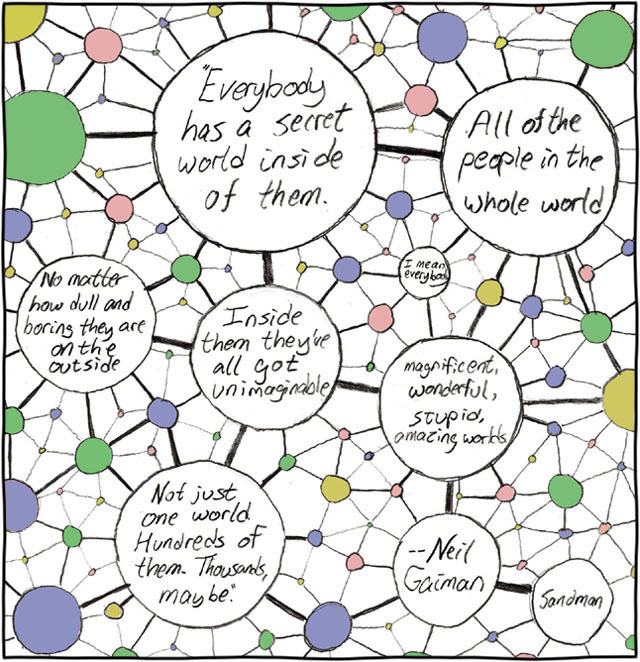
Speaking of Gatsby's deepest secrets, here's an xkcd picture I like. I think I used it for Never Let Me Go, but it really fits the wealthy characters in this novel, too. Behind Gatsby's countenance is his crazy longing for Daisy Buchanan. I like him -- he seems more modest and casual than the other wealthy characters, but his obsession with Daisy is a little creepy, and there's no doubt that he's materialistic, as well.
Gatsby: Some Help from Google
". . . I was standing beside his bed and he was sitting up between the sheets, clad in his underwear, with a great portfolio in his hands.
'Beauty and the Best . . . Loneliness . . . Old Grocery Horse . . . Brook'n Bridge . . .'" (The Great Gatsby, 38).
Fitzgerald adds quite a few allusions that gracefully place this novel in the Jazz Age. There are references to powerful figures like Morgan and Rockefeller. In Tom's apartment, copies of Town Tattle are on the table at a time when tabloids were becoming very popular (29). The orchestra at Gatsby's mansion plays a song called Jazz History of the World (49). My "things I learned in APUSH" label is slowly but surely climbing up my list of labels.
But what the crap is this at the end of chapter two? Is it even an allusion? I realize that at this point, Nick is completely wasted. He says that this was the second and final time he ever got drunk, which I think just makes his character more sympathetic (29). But I'd still like to know what he's talking about here. Ready? I'm going to google this quote and see what comes up; hopefully, I can find enough information to do my blog justice.
Oh, I see -- most people seem to think that Nick put Mr. McKee to bed, and the "great portfolio" has pictures in it. Likely, the titles of the pictures are "Beauty and the Beast," "Loneliness," "Old Grocery Horse," and "Brook'n Bridge." That's not very exciting, and if they're allusions, I don't get them. "Brook'n Bridge" kind of sounds like "broken bridge," which could refer to Myrtle's nose.
'Beauty and the Best . . . Loneliness . . . Old Grocery Horse . . . Brook'n Bridge . . .'" (The Great Gatsby, 38).
Fitzgerald adds quite a few allusions that gracefully place this novel in the Jazz Age. There are references to powerful figures like Morgan and Rockefeller. In Tom's apartment, copies of Town Tattle are on the table at a time when tabloids were becoming very popular (29). The orchestra at Gatsby's mansion plays a song called Jazz History of the World (49). My "things I learned in APUSH" label is slowly but surely climbing up my list of labels.
But what the crap is this at the end of chapter two? Is it even an allusion? I realize that at this point, Nick is completely wasted. He says that this was the second and final time he ever got drunk, which I think just makes his character more sympathetic (29). But I'd still like to know what he's talking about here. Ready? I'm going to google this quote and see what comes up; hopefully, I can find enough information to do my blog justice.
Gatsby: The Green Light
"Involuntarily I glanced seaward -- and distinguished nothing except a single green light, minute and far way, that might have been the end of a dock" (The Great Gatsby, 21).
After Nick's comically horrible dinner party in East Egg, he sees Mr. Gatsby alone outside of his mansion stretching his arms out toward the water and trembling. All that Nick sees is a green light across the water, which I decided must be a symbol for something! For Gatsby, the green light represented something for which he was hoping, searching, and yearning. Or, you know, someone.
Chapter four presents Jordan Baker's little frame story that unites all of Nick's previous anecdotes. Jordan tells Nick, "Well, about six weeks ago, she heard the name Gatsby for the first time in years" (77). That was back in the dinner party from chapter one when Jordan brought up the name Gatsby, someone she knew from West Egg. Jordan also tells Nick, "Then he [Gatsby] began asking people casually if they knew her, and I was the first one he found" (79). That was back in chapter three when Gatsby secretly spoke to Jordan, leaving Nick alone to observe Gatsby's inebriated guests.
Jay Gatsby and Daisy Fay shared a brief special connection in the past but then went their separate ways. When they reunite in chapter five, Mr. Gatsby tells Daisy, "'You always have a green light that burns all night at the end of your dock'" (92). Nick eloquently notes, "His count of enchanted objects had diminished by one" (93). Even though years passed, Gatsby has maintained his (slightly creepy) wonder and appreciation for Daisy Buchanan.
I think this is an important theme in the novel about the obsession of the determined heart of man. "No amount of fire or freshness can challenge what a man will store up in his ghostly heart" (96).
Labels:
anecdote,
Fitzgerald,
frame story,
novels,
structure,
symbol,
theme
Gatsby: Introducing the Rich People
"I lived at West Egg, the -- well, the less fashionable of the two, though this is a most superficial tag to express the bizarre and not a little sinister contrast between them" (The Great Gatsby, 5).
The two dueling settings in The Great Gatsby are East Egg and West Egg. From how Nick describes the two locations, I've decided that East Egg is more fashionable, condescending, lazy, and rich. Let's talk about the Tom and Daisy Buchanan, whom Nick visits in East Egg.
Tom Buchanan is "enormous," "supercilious," "wealthy," and a college football player (5-7). Nick hilariously calls him "one of those men who reach such an acute limited excellence at twenty-one that everything afterward savors of anticlimax" (6). Oh, and he's having an affair with some materialistic married girl named Myrtle.
If I had to choose one word to describe Daisy Buchanan, it would be "insecure." When her daughter was born, Daisy said, "'I'm glad it's a girl. And I hope she'll be a fool -- that's the best thing a girl can be in this world, a beautiful little fool'" (17). That insecurity of hers is clarified quite a bit in chapter four when Jordan tells Nick about the night before Daisy's wedding: "'Tell 'em all Daisy's change' her mine. Say: "Daisy's change' her mine!"'" (76). Her relationship with Tom is very weak, but she really hits it off with Mr. Gatsby.
I've got to finish off with a few more ironies I enjoyed. Tom says, "'Don't believe everything you hear, Nick'" shortly before his wife says, "'We heard it from three people, so it must be true'" (19). I also liked Tom's racist comment that "'we've produced all the things that go to make civilization'" as he lazily enjoys a luxurious meal in a lavish house in a fashionable area, none of which he actually worked for himself (13).
Gatsby: Introducing Nick Carraway
"'Whenever you feel like criticizing any one,' he [my father] told me, 'just remember that all the people in this world haven't had the advantages that you've had'" (The Great Gatsby, 1).
I haven't quite decided whether I should endow Nick Carraway or Mr. Jay Gatsby with the title of "protagonist" quite yet, but Nick is certainly the narrator. This quote from his father -- the idea that "a sense of the fundamental decencies is parcelled out unequally at birth" -- is central to Nick's character. Although the vastly wealthy people around Nick don't behave very respectably, our narrator reserves judgment, which opens him up to the deep secrets of other characters like Mr. Gatsby.
I really like Nick's character, partly due to his modesty. Around his wealthy acquaintances, Nick admits, "'You make me feel uncivilized, Daisy.'" Calling himself uncivilized among a house full of extremely hypocritical, racist, materialistic, and impulsive characters (more on that in my next post) is modest, in addition to being ironic. I'm very fond of Nick's voice; his sarcasm is very witty and thoughtful, and it goes way over the heads of the Buchanans. "'Do you want to hear about the butler's nose?' 'That's why I came over to-night'" (13).
One of Nick's iffy spots would probably be his incredulity. "He [Gatsby] looked at me sideways -- and I knew why Jordan Baker had believed he was lying" (65). At one point, he was so disbelieving that he had to restrain laughter at Gatsby's story. But everything becomes true to Nick when he sees physical proof: Gatsby's war medal and picture from Oxford. In my opinion, even his skepticism is likable -- in Nick's defense, he's around a bunch of secretive wealthy people, so being suspicious is no crime.
Fun fact: this Christmas, while Leonardo DiCaprio will be portraying Mr. Gatsby, Tobey Maguire will be taking the role Nick Carraway in The Great Gatsby! Your friendly neighborhood Spiderman.
Subscribe to:
Posts (Atom)