Showing posts with label fate. Show all posts

Tuesday, April 3, 2012

I ought to be thy Adam!

"My heart, which was before sorrowful, now swelled with something like joy; I exclaimed -- 'Wandering spirits, if indeed ye wander, and do not rest in  your narrow beds, allow me this faint happiness, or take me, as your companion, away from the joys of life.'

As I said this, I suddenly beheld the figure of a man, at some distance, advancing towards me with superhuman speed" (Frankenstein, 67-8).

The timing here is just hysterical.

This quote goes along with the idea of destiny throughout the story. No matter how much Victor tries to escape, fate has a monopoly on his life. I noticed this earlier when Victor temporarily abandons his scientific studies -- he says, "Destiny was too potent, and her immutable laws had decreed my utter and terrible destruction" (23). Now, in chapter ten, Frankenstein might as well say, "Fates, if you really hate me this much, take away my happiness right . . . now!" So they did.

Victor believes that his only destiny is to be unhappy, which makes perfect sense considering the hell he's been through. He puts down the science books for a while, he returns to his family in Geneva, and he takes a little trip through the mountains after Justine's death, but his only happiness is ever temporary. We discussed in class how "nature vs. nurture" applies to the creature, that Victor believes the creature is evil by nature but the creature believes he is evil by nurture. I think we can apply the same idea to Victor. His natural qualities of curiosity and work ethic help elicit his "remorse" and "guilt" by this point in the story (61). Frankenstein presents a theme that I don't necessarily agree with, that destiny is unavoidable.

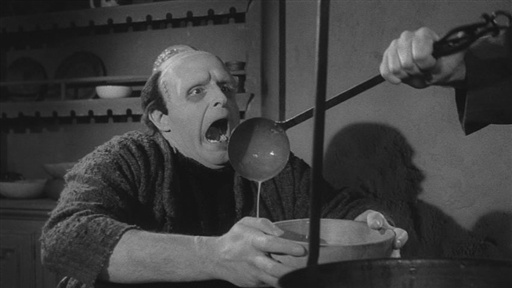
By the by, I haven't quite decided if the creature's eloquent rhetoric is a reversal of expectations or not. Perhaps there's no situational irony. Before Victor agrees to hear the creature's story, he calls him "vile insect," "abhorred monster," and "wretched devil" (68), but he has yet to say something like, "Hast thou seriously acquired thine mastery of language from the likes of three destitute neighbors? And as thou knowest all by means of observation, whence did you learn how to pee?" (Thanks to Louise for that thought-provoking notion.)
Tuesday, September 6, 2011

"And took he forth a saw, and cleft her in twain."

"Till the Spinner of the Years / Said 'Now!' And each one hears, / And consummation comes, and jars two hemispheres" ("The Convergence of the Twain," 31-33).

The only other time I remember hearing the word "twain" is in Rowan Atkinson's "Amazing Jesus." The part I quoted is between 2:35 and 2:55:


At first, when I read the title and the helpful epigraph, I thought that the "twain" might have been two halves of the ship, or something. Did the Titanic break in two? I don't know these things.

However, the "twain" are the vain and "opulent" Titanic (8) and its "sinister mate" (19), the iceberg. Of course, the poem's denotative situation is the meeting of those two separate spheres. What I liked about the structure was that in each stanza, there were two lines of approximate length x followed by a third line of approximate length 2x. The stanza construction in which two lines "converged" into a third line that was twice as long reflects the convergence of the Titanic and the iceberg.

The other question I want to answer is what I think of the "Immanent Will" and the "Spinner of the Years." I absolutely loved the final stanza where "the Spinner of the Years / Said 'Now!'" (31-32). At first, it made me think of God's commands in the creation story. However, I don't think God is the undefined Being in the poem. The text says that the Being created "a sinister mate" (19), which is not what an benevolent God would do; it also uses the word "consummation" (33), which suggests to me a fulfillment of what was inevitably going to occur. Therefore, I think the "Immanent Will" and the "Spinner of the Years" are fate.